
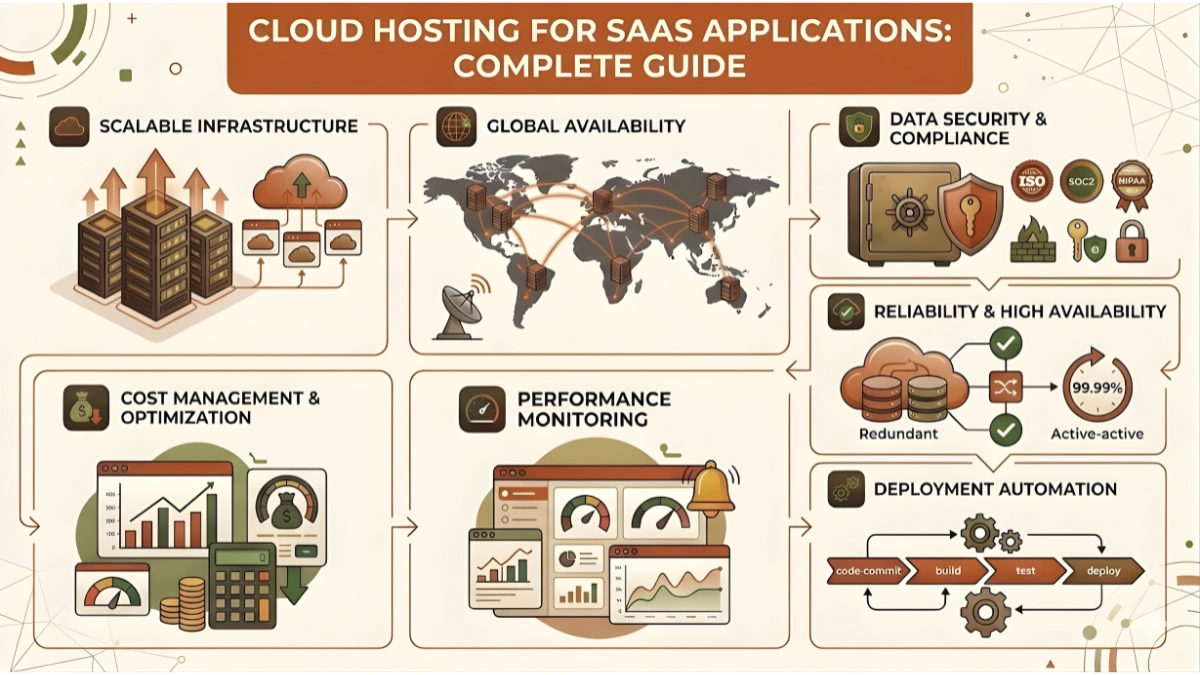
Cloud hosting has become the foundation for most SaaS applications because software products require stable uptime, fast response time, and the ability to serve many users at the same time without performance loss. In 2026, SaaS businesses depend heavily on cloud infrastructure because application traffic can grow quickly as customer adoption increases. Unlike normal websites, SaaS platforms often process logins, dashboards, databases, API requests, and background tasks continuously, which creates much higher server demand. A cloud environment gives SaaS applications the flexibility to scale resources whenever usage increases, while also keeping application availability strong across different regions. For software businesses, cloud hosting is not simply about storage but about maintaining reliable product performance every day.
Why SaaS Applications Need Cloud Infrastructure
A SaaS product usually serves multiple users simultaneously, which means server resources must remain stable even when many actions happen at once. User logins, dashboard generation, file handling, and background processing all consume server capacity continuously. A traditional hosting environment often struggles under this type of workload because resources are limited to one machine or one fixed plan. Cloud hosting solves this by distributing resource demand across connected systems, allowing the application to remain responsive during growth periods. This makes cloud infrastructure one of the strongest choices for software businesses expecting customer expansion.
Why Scalability Is Critical for SaaS Products
A SaaS application may start with a small user base but can quickly require more CPU, RAM, and storage as customer adoption increases. Cloud hosting allows these resources to expand without forcing a complete migration to a new server. This is important because SaaS businesses often cannot afford downtime while moving infrastructure. The ability to increase resources gradually also helps founders control cost while still preparing for product growth.
| SaaS Requirement | Hosting Focus | Main Strength |
|---|---|---|
| Multi-user access | Scalable cloud resources | Stable concurrent performance |
| Application uptime | Multi-server infrastructure | Reduced downtime risk |
| API workloads | Flexible compute power | Faster request handling |
| Database activity | High-performance storage | Better response speed |
| Product growth | Easy scaling options | Long-term flexibility |
Managed Cloud Hosting Helps Smaller SaaS Teams
Cloudways remains attractive for smaller SaaS teams because server management tasks such as backups, monitoring, and security become easier through one dashboard. Smaller software teams often prefer managed environments because they can focus more on product development instead of daily infrastructure maintenance.
Why Enterprise SaaS Platforms Prefer Broad Cloud Ecosystems
Amazon Web Services remains highly preferred because SaaS applications often need databases, object storage, load balancing, and advanced networking inside one ecosystem. Large cloud environments support all these services together, which helps software businesses build long-term architecture without changing providers.
Database Performance Matters for SaaS Growth
SaaS applications often depend heavily on databases because every user action may trigger reads and writes. A cloud hosting plan must therefore provide strong storage performance and reliable backup systems. Weak database speed often becomes the first visible bottleneck when SaaS traffic increases.
Why Security Is Essential for SaaS Hosting
SaaS platforms often manage customer accounts, internal records, and application data, which means hosting security must include backups, encrypted connections, firewall controls, and controlled access policies.
Conclusion: Cloud hosting is essential for SaaS applications because it supports scaling, uptime, database performance, and long-term product growth under real user demand.
Disclaimer: Actual hosting requirements vary depending on user volume, application architecture, database load, and regional traffic patterns.