
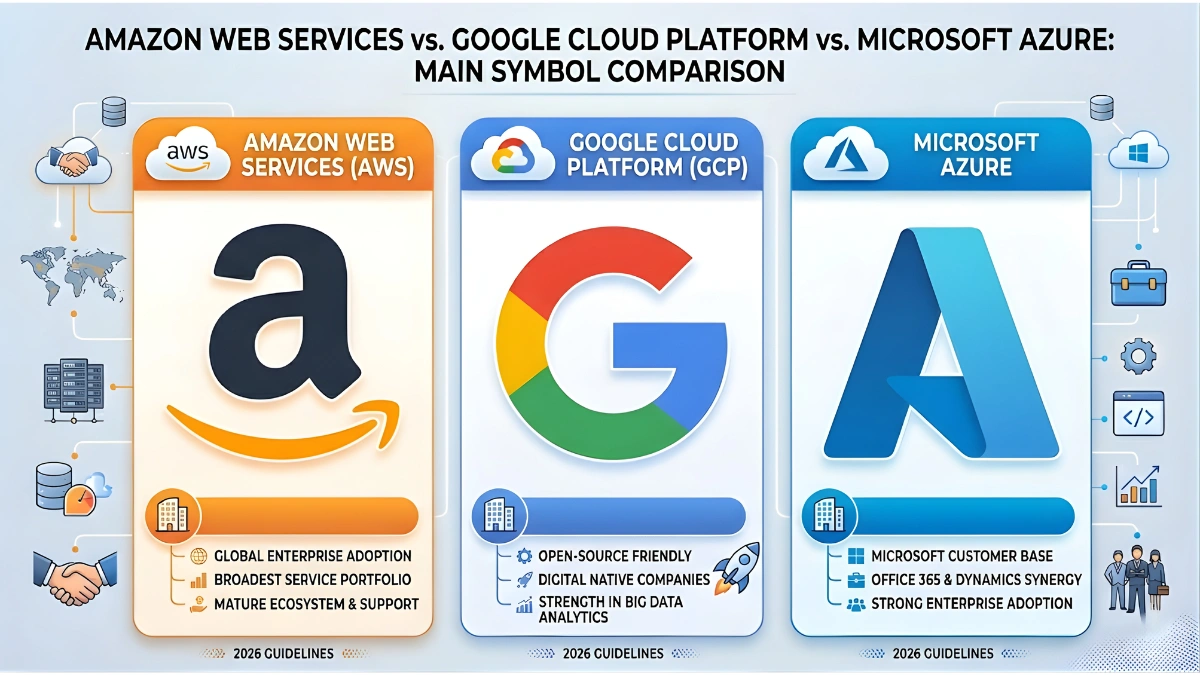
Cloud platform selection has become one of the most important infrastructure decisions for modern businesses because the right provider directly affects operating cost, scalability, application speed, and long-term digital growth. In 2026, Amazon Web Services, Google Cloud Platform, and Microsoft Azure remain the three strongest global cloud providers, but each platform offers different advantages depending on workload type, enterprise requirements, and technical priorities. Businesses usually compare them based on pricing flexibility, global infrastructure, AI capability, and compatibility with existing systems.
Why Amazon Web Services Leads in Service Variety
Amazon Web Services remains the most extensive cloud ecosystem because it offers hundreds of services covering storage, databases, machine learning, serverless systems, networking, and enterprise infrastructure. Businesses often choose AWS when they expect long-term expansion because almost every advanced cloud requirement can be handled inside one platform. Its wide global region network also supports strong international deployment.
Why Google Cloud Platform Is Strong for Data and AI
Google Cloud continues gaining strong attention because it performs especially well in analytics, machine learning, and modern application deployment. Businesses handling large datasets often prefer Google Cloud because its infrastructure is highly optimized for data processing. Many developers also prefer its cleaner console and pricing transparency.
| Comparison Area | Amazon Web Services | Google Cloud Platform | Microsoft Azure |
|---|---|---|---|
| Main Strength | Broad service ecosystem | Strong analytics and AI tools | Enterprise integration |
| Pricing Style | Flexible but complex | Transparent sustained pricing | Enterprise contract advantage |
| Best For | Large-scale cloud workloads | Data-heavy applications | Microsoft ecosystem businesses |
| Scalability | Very high global flexibility | Strong automatic scaling | Hybrid cloud expansion |
| Learning Curve | Advanced service depth | Cleaner interface | Easier for Microsoft users |
Why Microsoft Azure Dominates Enterprise Adoption
Microsoft Azure remains highly preferred among enterprises already using Microsoft systems such as Windows Server, Microsoft 365, and SQL Server. This compatibility reduces migration difficulty and allows businesses to integrate existing tools into cloud operations more smoothly. Azure is also very strong in hybrid cloud environments.
Pricing Differences Matter at Scale
All three providers use flexible usage-based pricing, but cost behavior changes as workloads grow. AWS often gives maximum flexibility but needs careful cost monitoring. Google Cloud becomes attractive for stable workloads because pricing remains easier to estimate. Azure often gives strong value when businesses already operate inside Microsoft licensing structures.
Performance Depends on Workload Type
AWS often performs best for broad infrastructure needs, Google Cloud excels in analytics-heavy environments, and Azure performs strongly in enterprise continuity scenarios. The best performance choice usually depends on whether the business prioritizes AI, application hosting, enterprise software, or global deployment.
Which Platform Gives the Best Long-Term Value
The strongest long-term value depends on business direction. AWS fits businesses needing maximum service range, Google Cloud fits analytics and AI-driven growth, and Azure fits organizations deeply connected to Microsoft systems.
Conclusion: AWS, Google Cloud Platform, and Microsoft Azure all remain powerful in 2026, but the best choice depends on whether a business values service depth, analytics power, or enterprise compatibility most strongly.
Disclaimer: Cloud pricing, service availability, and included features can change depending on provider updates, workload scale, and regional deployment choices. Businesses should compare current service details before final infrastructure decisions.