
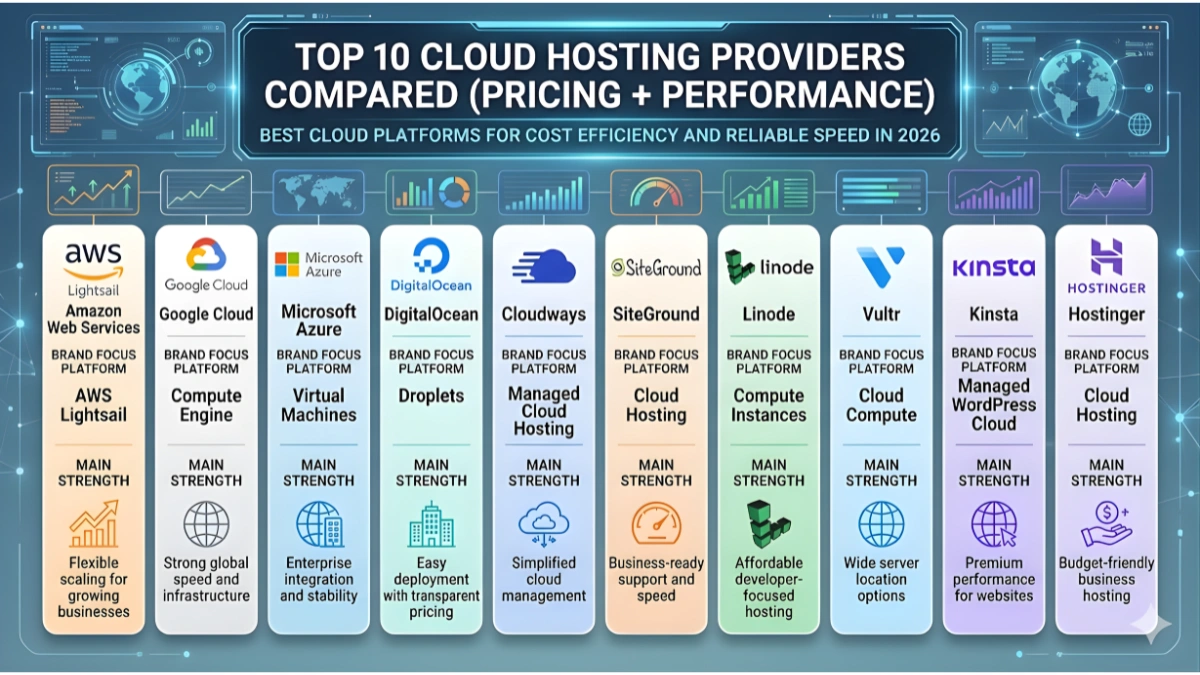
Cloud hosting providers are increasingly compared on two major factors: pricing flexibility and performance stability. In 2026, businesses no longer choose hosting only by low monthly cost because website speed, uptime consistency, and scaling options now directly affect online growth, lead generation, and customer trust. From startups to growing online businesses, cloud infrastructure has become the preferred solution because it offers stronger reliability than traditional shared hosting while allowing resources to expand as traffic grows.
| Brand Focus | Platform | Main Strength |
|---|---|---|
| Amazon Web Services | AWS Lightsail | Flexible scaling for growing businesses |
| Google Cloud | Compute Engine | Strong global speed and infrastructure |
| Microsoft Azure | Virtual Machines | Enterprise integration and stability |
| DigitalOcean | Droplets | Easy deployment with transparent pricing |
| Cloudways | Managed Cloud Hosting | Simplified cloud management |
| SiteGround | Cloud Hosting | Business-ready support and speed |
| Linode | Compute Instances | Affordable developer-focused hosting |
| Vultr | Cloud Compute | Wide server location options |
| Kinsta | Managed WordPress Cloud | Premium performance for websites |
| Hostinger | Cloud Hosting | Budget-friendly business hosting |
Why Pricing Comparison Matters More in 2026
Businesses increasingly compare cloud hosting pricing because low entry plans often exclude important features such as backups, advanced support, CDN integration, and security protection. Entry-level cloud hosting may appear affordable initially, but additional bandwidth or server upgrades can raise long-term operating cost. Providers that offer transparent billing and predictable scaling usually attract stronger business demand because cost planning becomes easier for growing websites.
Why AWS Continues Leading Large Cloud Demand
Amazon Web Services remains one of the strongest providers because AWS Lightsail offers simplified pricing while still giving access to enterprise-grade infrastructure. Small businesses often begin with lower-cost plans and later scale toward stronger computing resources without changing platforms. This flexibility makes AWS attractive for companies expecting gradual digital growth.
Performance Matters for Search Rankings and User Trust
Website speed directly influences bounce rate, search visibility, and user engagement. Google Cloud remains highly preferred because its global infrastructure supports low latency and stable delivery across multiple regions. Faster response time becomes especially valuable for websites running forms, online bookings, product pages, or content-heavy business portals.
Why Managed Cloud Hosting Keeps Growing
Cloudways continues attracting businesses because it simplifies complex infrastructure into one easy management panel. Many business owners prefer this because server updates, backups, caching, and security settings are already built into the system. This reduces technical workload while still allowing use of powerful infrastructure providers underneath.
DigitalOcean Remains Popular for Simplicity
DigitalOcean is widely preferred by startups and small digital businesses because pricing remains easy to understand and deployment happens quickly. Businesses with technical flexibility often choose this provider because resources can be adjusted without enterprise-level complexity.
Why Premium Providers Still Attract Buyers
Premium cloud hosting providers such as Kinsta and SiteGround continue attracting businesses that prioritize support quality and managed performance. Many business websites value premium support because fast issue resolution prevents downtime and protects business activity during technical problems.
Why Cloud Hosting Demand Continues Expanding
Cloud hosting is no longer limited to software companies because service businesses, agencies, eCommerce stores, and content publishers now all require stable infrastructure. As websites become more important for revenue generation, businesses increasingly treat hosting quality as a strategic investment rather than a basic technical expense.
Conclusion: The top cloud hosting providers in 2026 are those that balance affordable pricing, stable performance, and practical scaling options for both small and growing businesses.
Disclaimer: Hosting plans, pricing, and included resources may vary by provider, billing period, and regional availability. Businesses should compare live specifications before choosing a final hosting solution.